 Linen |
|||||||||
 Lycia Sculpture and Linen Memorial on Facebook
 |
| Photographs: Kathy Bernett, Diana Cullum-Hall |
Lycia Trouton
The Linen Memorial:
A Gathering of Names
Paper and short Soundscape Presentation of Names List presentation
Co-Author & Soundscape: Stephen Perrett
My (Irish) Linen Memorial is an intervention of a 'modest witness', in the intimate and historic medium of Irish linen. It is my Irish Diaspora contribution to commemorating those killed in the Northern Ireland Troubles. Its early role, given it was started in 2001, was not only to 'heal through remembrance', but also to work against the tide of continued violence and terror in post-conflict Northern Ireland. This paper is about the 2009 digitization of the memorial for The Canada Room at Queens on June 21st, The third annual Private Day of Reflection and for the web , 'A Gathering of Names' surround Soundscape, 2009, randomises the names list of all those killed and uses auditory spatial localisation for visitors to the memorial looking for loved ones.
11.30 am, Saturday, August 29th
Waterfront Hall, Belfast, Lanyon Place
Waterfront Hall, Belfast, Lanyon Place
Third Annual Day of Private Reflection
June 21st 2009
Digital Viewing of the Linen Memorial
 |
 |
 |
 |
 |
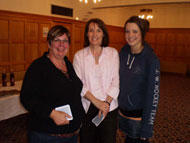
50/60 viewers throughout the day visited the Linen Memorial, mostly general public with many international folk from countries such as India, France, Poland, USA. Most tourists visiting Belfast are here to see the aftermath of the Troubles, so the Irish Linen Memorial theme ties in with this. For locals it’s still quite a raw subject, having known so much pain and sadness through the countless deaths over the 40 years. The viewing was covered by the BBC and RTE (Radio TV Eire) Invited Speakers:
Invited Speakers:
Rowan Hand, Broadcaster
Martin Dunphy Charity worker (formerly of Peace People, 1970s)
Host: Australian Artist Krisee Oliver
Additional hosts: The Hanson Family
Rowan Hand, Broadcaster
Martin Dunphy Charity worker (formerly of Peace People, 1970s)
Host: Australian Artist Krisee Oliver
Additional hosts: The Hanson Family
Public viewing of the Linen Memorial Handkerchiefs
The presentation at the Centre for Peace at the Canadian Memorial United Church on the longest day of the year, June 21st, saw a number of visitors and church members attending... There are so many names embroidered that even when just over half the handkerchiefs are laid out...laid flat and close together, they covered ten standard long tables as well, and were also pinned to white drapes covering over the surrounding screens. The Canadian Memorial Church was built in remembrance of those who died in war, and on Remembrance Day, November 11, 1928, it was dedicated to the cause of peace. Lycia is appreciative of all the volunteer assistance. This year, the longest day (in the Northern Hemisphere), was also Father's day, so I have to also say a sincere 'thank you' to all of you who have become intimate with the Irish Linen Memorial through my daughter. Thanks to The Canadian Memorial Centre for Peace for giving the (Irish) Linen Handkerchief Memorial its own moment.
s
Robert Wakefield and Maureen Anne Salus Trouton
Hosts: Robert and Maureen Trouton

A Gathering of Names - Names Reading, 2009
The new soundscape was made with Dr. Stephen Perrett, psycho-acoustics, with readers from the Northern Ireland and Ireland Diaspora communities of Canberra, ACT, Australia and Vancouver, Canada. Eight spatially separate loudspeakers are used to present the names readings. Each reader’s recording will be played back via one particular loudspeaker. All recordings would be played back at the same time thereby simulating 8 spatially separate human readers all reading names simultaneously.
The Linen Memorial
The Linen Memorial was conceived and created in 2001 as a way in which art may contribute to healing the wounds of The Troubles. by sculptor Lycia Danielle Trouton, (born Belfast).
It is an alternative history of The Troubles in Northern Ireland. It can be understood as a counter-monument which is a non-heirarchical list of names of those killed in order to remember the people.
Names are being slowly embroidered onto handkerchiefs; a funerary record of the toll of human lives during Northern Ireland's sectarian violence; persons listed (commemorated) are on ALL sides of the political divide, listed without bias.
The original artwork was conceived and developed in February 2001, with my visual art Canada Council of the Arts funding, and was exhibited from September 7, 2001 to October 20, 2001 as part of the Natural Causes exhibit, in Ellensburgh, near Seattle, Washington, U.S.A.; curator Cheryl Hahn. My artwork was entitled, Between Worlds: The Common Body in a group exhibition on the theme of the ways in which one?s identity or autobiography was informed by one's landscape art practice. I created an installation 'room' where the drapery formed four walls of a memorial, beneath a blacked-out skylight in a foyer at the top of a flight of over twenty-five steep steps. In the centre of this room was a coffin-sized configuration of blocks of compressed peat moss (similar to Irish bog oak), upon which an image of a body was projected.
The list and order of names of all those killed is held in the public record and is also freely available on the world wide web yet primarily attributed, by the chronological listing, to David McKittrick, Seamus Kelters, Brian Feeney, David McVea and Chris Thornton, "Lost Lives: The Stories of the Men, Women and Children Who Died as a Result of the Northern Ireland Troubles" (Mainstream Publishing: 2000). In an “act of public service journalism;” these journalists used pinpointed the moment of each person’s death, linked these deaths with contemporary computer-aided database search and file techniques, in effect “patterning” the deaths together; as well, they catalogued general factual information about the person’s life and, in a poignant way, documented the moments before each person was killed.
The inclusion of all the names of the dead is controversial as it is non-hierarchical: perpetrators or terrorists are listed alongside victims; persons on either side of the sectarian divide are listed one after another. I do not make attempts at categorization regarding affiliations. The (Irish) Linen Memorial presents dispassionate and the unembellished facts of a names list on linen. My transposition of a names list onto a textile medium places a feminist emphasis upon the body. The private rituals of grief, mourning and continued attempts at healing from trauma can be categorized as types of commemorative practices, without losing sight of the divisive social-historical context within which those killings occurred due to the conflict.
The (Irish) Linen Memorial explores underlying conceptual themes governing the binary opposites of intimacy/politics, public and private, investigative journalism and commemorative art-making, and suggests a movement beyond extreme divisions through an exploration of the excluded middle (E.Grosz). By doing so, I am working to dissolve, undo or unpick differences. The (Irish) Linen Memorial is an artwork based on contemporary research at the intersection between grief and post-traumatic stress, drawing on contemporary cultural history and ‘memory studies’. The construction of the memorial was also informed by my personal artistic journey as a member of the Irish Diaspora to the countries of Canada (1970 – 84), U.S.A.(1985 – 2000), Australia (2001 – 2005) and Northern Ireland in both 1999 and again in 2006 –8.
Throughout the creation of the memorial, I imagined its eventual unveiling as a public art piece in an interface neighbourhood such as at The Waterworks in North Belfast or in Omagh or Derry, Northern Ireland. This has yet to be determined. In 2011, the memorial will tour in Quebec, Canada, as a part of the Flax and Linen Biennale. This artwork contributes to the debate about whether or not the poetics of art traverses politics. It is my hope that the The (Irish) Linen Memorial may aid with new theories of interculturalism in Northern Ireland/Ireland, public citizenship in an wired, highly mobile[xi] age in the U.K. and Ireland, and Irish Diaspora migration studies to do with kinship and interculturalism. As well, as a metaphor for social change, the artwork-memorial-counter-monument may be able to aid scholarship about sustainable cross-community relations and/or restorative justice initiatives in Northern Ireland.
In post-conflict Northern Ireland, people can visit The Linen Memorial annually on The Private Day of Reflection. From 2007, Northern Ireland introduced an 'open' Day of 'Private' Reflection on the summer solstice, 21st July, to consider the conflict and to think about those killed. In 2007 and 2008 The Linen Memorial was at The CroÍ at The Corrymeela Community, Ballycastle, N. Ireland.
The Linen Memorial is dedicated to those who live with ongoing trauma and grief.

